
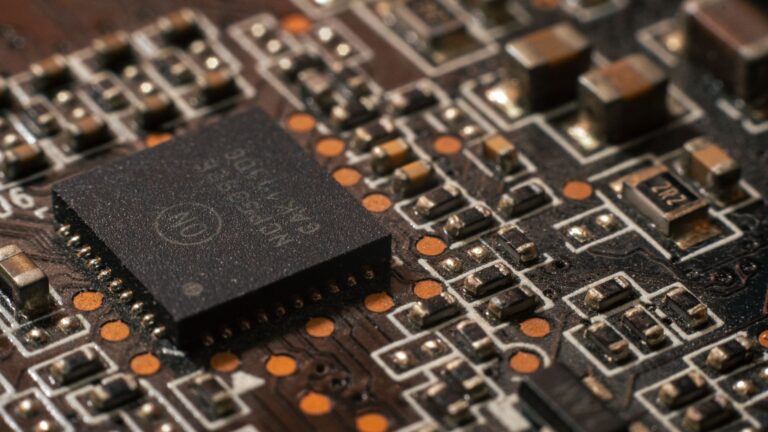
Understanding the Core: What Is an AI Chip?
When you hear the term “AI chip,” you might picture a futuristic processor tucked inside a sleek robot. In reality, an AI chip is any semiconductor designed to accelerate artificial‑intelligence workloads—tasks such as deep‑learning inference, neural‑network training, and large‑scale data analysis. While traditional CPUs can run AI algorithms, they do so inefficiently compared to purpose‑built silicon that can handle the massive parallelism and high‑throughput demands of modern models.
Why General‑Purpose Processors Aren’t Enough
CPUs (central processing units) excel at sequential processing and flexible instruction handling. They are the workhorses of laptops, servers, and smartphones. However, deep‑learning models often involve billions of simple arithmetic operations—matrix multiplications, convolutions, and element‑wise functions—that can be performed simultaneously. GPUs (graphics processing units) were the first to fill this gap by offering thousands of cores optimized for parallel floating‑point work, which made them popular for AI research.
Even so, GPUs are still general‑purpose graphics accelerators. Their architecture includes features that are unnecessary for AI, such as rasterization pipelines and texture units, which consume die space and power. AI chips strip away these extras, focusing on the specific computational patterns that neural networks use, delivering better performance per watt and allowing smaller form factors for edge devices.
Key Architectural Features of AI Chips
- Matrix Multiply‑Accumulate (MAC) Units: The heart of neural‑network calculations, MAC units perform the multiply‑and‑add steps that dominate deep‑learning workloads.
- On‑Chip Memory (SRAM) and High‑Bandwidth Buffers: Storing weights and activations close to the compute units reduces latency and energy consumption compared to fetching data from DRAM.
- Tensor Cores / AI Accelerators: Specialized functional blocks that execute whole tensor operations (multi‑dimensional arrays) in a single instruction, dramatically speeding up matrix math.
- Low‑Precision Arithmetic: Many AI models tolerate reduced precision (e.g., 8‑bit integers or 16‑bit floating point) without sacrificing accuracy, allowing chips to double throughput while cutting power draw.
- Programmable Interconnects: Flexible data pathways let designers map different neural‑network topologies efficiently, from convolutional layers to transformers.
These features together create a pipeline that moves data through the compute fabric with minimal bottlenecks, delivering the speed required for real‑time inference on devices ranging from autonomous vehicles to smart speakers.
From Data Centers to Edge Devices: The Growing Ecosystem
AI chips are no longer confined to massive server farms. The industry now offers a spectrum of solutions tailored to where the computation happens:
Data‑Center Accelerators – Large silicon dies with thousands of MAC units, designed for training huge models on clusters of servers. They typically interface via PCIe or proprietary high‑speed fabrics and prioritize raw throughput.
Edge AI Processors – Compact, power‑efficient chips that can sit inside smartphones, drones, or IoT sensors. They often integrate CPU cores, DSPs (digital signal processors), and AI accelerators on a single die, enabling on‑device inference without reliance on cloud connectivity.
Embedded Modules – System‑in‑package (SiP) or module solutions that bundle an AI chip with memory, power management, and sometimes a tiny GPU, providing a turnkey platform for developers building smart appliances or industrial robots.
This diversification reflects a broader shift: AI is moving from the cloud to the “fog,” where latency, privacy, and bandwidth constraints demand that inference occur as close to the data source as possible.
Design Challenges: Power, Heat, and Flexibility
Building an AI chip is a balancing act. Engineers must squeeze performance out of a limited silicon budget while keeping power consumption low enough to avoid overheating, especially in edge devices. Some of the main hurdles include:
- Thermal Management: Dense compute units generate heat quickly. Advanced packaging techniques—such as 3D stacking, chip‑on‑wafer, and integrated cooling solutions—help dissipate heat without sacrificing performance.
- Precision Trade‑offs: Deciding which numerical precision to support involves evaluating model accuracy versus hardware efficiency. Many modern frameworks now offer quantization tools that automate this process.
- Software Stack Integration: Without robust compilers, libraries, and runtime environments, even the most powerful silicon remains underutilized. Companies therefore invest heavily in SDKs that translate high‑level AI frameworks (like TensorFlow or PyTorch) into hardware‑specific instructions.
- Scalability: A chip that shines in a single‑device scenario must also scale across hundreds or thousands of nodes in a data center, requiring consistent performance and predictable interconnect behavior.
Addressing these challenges often drives innovation not just in the silicon itself but also in packaging, cooling, and software ecosystems.
Industry Players and the Landscape of AI Chips
While the market is dynamic, a handful of companies have established notable AI‑focused product lines:
Traditional Semiconductor Leaders – Companies such as NVIDIA and AMD, originally known for GPUs, have released dedicated AI accelerators (e.g., NVIDIA’s Tensor Core GPUs and AMD’s Instinct series) that extend their graphics heritage into the AI domain.
Specialized AI Startups – Firms like Graphcore, Cerebras, and SambaNova have introduced novel architectures, including massive wafer‑scale engines and graph‑processing units, targeting specific bottlenecks in large‑scale model training.
Integrated Device Manufacturers – Apple, Qualcomm, and MediaTek embed AI engines directly into their system‑on‑chips (SoCs) for smartphones and wearables, leveraging tight integration to deliver on‑device inference for features like voice assistants and camera enhancements.
These players illustrate two parallel trends: the continuation of GPU‑derived acceleration and the emergence of purpose‑built silicon that departs from the graphics‑centric design philosophy.
The Road Ahead: What to Expect from Future AI Chips
As AI models grow more sophisticated—think multimodal transformers that handle text, images, and audio simultaneously—the demands on hardware will evolve. Anticipated developments include:
- Heterogeneous Compute Fabrics: Combining CPUs, GPUs, and AI accelerators on a single die with shared memory pools to reduce data movement overhead.
- Neuromorphic and Spiking Designs: Architectures that mimic brain‑like event‑driven processing, potentially offering ultra‑low power consumption for certain inference tasks.
- Advanced Packaging: Chiplets and interposer technologies that let designers mix and match compute modules, tailoring performance to specific workloads without redesigning an entire die.
- Security‑First Features: Built‑in encryption and attestation mechanisms to protect proprietary models and ensure trustworthy execution on edge devices.
Beyond pure performance, sustainability is becoming a key metric. Data centers now weigh the carbon impact of training large models, prompting designers to prioritize energy efficiency alongside raw speed.
Why It Matters to You
Even if you’re not building a self‑driving car, AI chips influence everyday experiences. The face‑unlock on your phone, the recommendation engine that suggests the next binge‑watch, and the smart thermostat that learns your schedule all rely on specialized silicon that can run complex inference quickly and privately. As these processors become more capable, they will enable new applications—augmented reality assistants, real‑time language translation, and personalized health monitoring—without needing constant cloud access.
Understanding what an AI chip is helps demystify the rapid advances we see in consumer tech and provides a glimpse into the infrastructure powering the next wave of intelligent services. Whether you’re a developer, a tech enthusiast, or simply a curious reader, recognizing the role of purpose‑built silicon is essential to appreciating how artificial intelligence moves from theory to tangible, everyday reality.
