
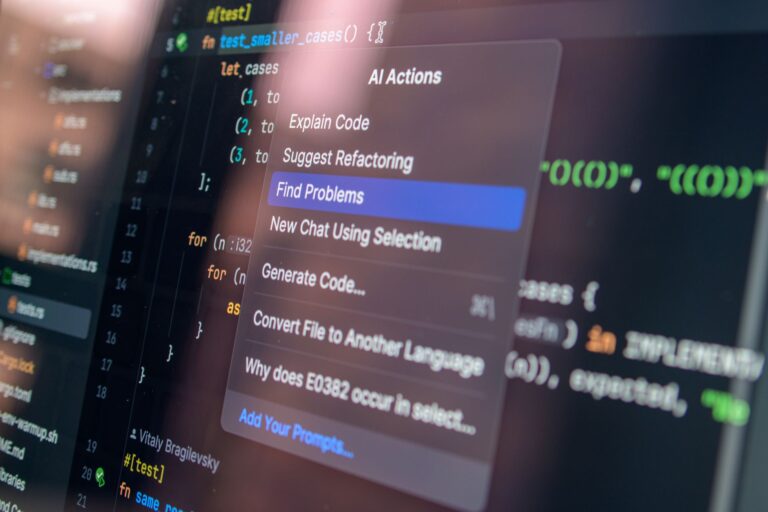
Defining AI‑Assisted Software Development
AI‑assisted software development refers to the use of machine‑learning models, natural‑language processing, and other artificial‑intelligence techniques to augment the coding workflow. Rather than replacing developers, these tools act as collaborative partners that can suggest code snippets, flag potential bugs, generate documentation, and even help design system architectures. The underlying premise is simple: by feeding large corpora of public code, documentation, and issue‑tracking data into sophisticated models, the system learns patterns that can be reused to accelerate repetitive or error‑prone tasks.
How the Technology Works
Most AI assistants are built on transformer‑based language models that have been pretrained on billions of lines of source code and natural‑language text. After the initial pretraining phase, the models are often fine‑tuned on more domain‑specific repositories to improve relevance. When a developer types a comment, function signature, or partial implementation, the model processes that context and generates a ranked list of completions. The interaction is typically mediated through an editor extension or a web‑based IDE, where the suggestions appear inline and can be accepted, rejected, or edited.
Key technical components include:
- Tokenization: Converting code and comments into a series of tokens that the model can understand.
- Context windows: Capturing a limited number of lines before and after the cursor to provide the model with enough information without overwhelming it.
- Sampling strategies: Deciding whether to prioritize the most likely output, encourage diversity, or balance between speed and accuracy.
These components are constantly refined, and many providers now offer cloud‑based inference services that keep the heavy computational load off the developer’s machine.
Core Benefits for Developers
When used responsibly, AI assistance can reshape everyday programming tasks. The most commonly reported advantages include:
- Speeding up boilerplate creation, such as data‑access layers or UI scaffolding.
- Reducing context‑switching by offering on‑the‑fly documentation or examples.
- Improving code consistency across teams, especially in large codebases.
- Lowering the barrier to entry for junior developers who can see concrete implementations of abstract concepts.
Beyond individual productivity, organizations can see a measurable impact on code quality. Early detection of common anti‑patterns or security vulnerabilities—often flagged by the same AI that generated the code—helps keep technical debt in check. Moreover, because the suggestions are generated in real time, the feedback loop between writing and reviewing code becomes tighter, which can foster a culture of continuous learning.
Real‑World Use Cases
AI assistance is already woven into a variety of development scenarios. In test‑driven environments, developers can ask the assistant to draft unit tests based on a function’s signature, then refine the generated tests to meet edge‑case requirements. In API development, the model can suggest endpoint definitions, request‑validation schemas, and even sample client code. For legacy modernization, AI can propose refactoring patterns that replace deprecated libraries with modern equivalents while preserving behavior.
Open‑source contributors often use AI tools to explore unfamiliar codebases. By prompting the model with a high‑level description of a module, they can receive concise overviews that accelerate onboarding. Similarly, data‑science teams leverage AI to translate analytical notebooks into production‑ready pipelines, converting exploratory code into maintainable modules.
Challenges and Ethical Considerations
Despite the promise, AI‑assisted development introduces several practical and ethical hurdles. One major concern is the risk of “code plagiarism.” Because models are trained on publicly available repositories, they may reproduce snippets that are subject to restrictive licenses. Developers must remain vigilant, reviewing generated code for licensing compliance and attribution requirements.
Another challenge is over‑reliance. When suggestions are accepted without scrutiny, subtle bugs or security flaws can slip into production. AI models, while impressive, do not possess true understanding of business logic; they operate on statistical patterns. This means they can confidently suggest syntactically correct but semantically incorrect code.
Privacy is also a factor. Some AI services process prompts on remote servers, raising questions about the confidentiality of proprietary code. Organizations need to assess whether on‑premise deployments or encrypted transmission meet their compliance standards.
Best Practices for Teams
Integrating AI assistance into a development workflow works best when combined with clear guidelines. Teams should consider the following practices:
- Establish review protocols: Treat AI‑generated code as a draft, subject to the same code‑review standards as any human contribution.
- Document usage policies: Define which parts of the codebase can be processed by external AI services and which must remain isolated.
- Educate developers: Provide training on prompt engineering, helping developers phrase requests to obtain the most relevant output.
- Monitor model outputs: Use static‑analysis tools to catch potential security or performance issues introduced by AI suggestions.
By treating AI as a collaborative assistant rather than an infallible oracle, teams can reap efficiency gains while maintaining high standards of code quality and compliance.
The Road Ahead
The next generation of AI‑assisted development is likely to be more context‑aware and integrated across the software lifecycle. Emerging research focuses on multi‑modal models that understand not only code but also diagrams, architecture diagrams, and even spoken specifications. This could enable developers to sketch a system in a visual tool and receive a corresponding code skeleton automatically.
In parallel, the industry is moving toward open governance frameworks that address licensing, attribution, and data provenance. Standards bodies are discussing how to certify AI models for security‑critical environments, which would make AI assistance viable in regulated sectors such as healthcare and finance.
Ultimately, AI‑assisted software development is not a fleeting trend; it is an evolving partnership that amplifies human creativity. When developers harness these tools with an awareness of their limits, they can focus more on problem solving, system design, and delivering value—while the AI handles the repetitive, detail‑heavy aspects of coding. The balance between automation and human insight will define the next era of software engineering, and the tools we adopt today will shape how we build the digital world of tomorrow.
